Yaakov Agam was born in 1928 in Palestine. He is a sculptor and did experiments in
optical and kinetic art. He got
his formal art training at the Bezalel Academy of Art and Design in
Jerusalem. He then moved to Zürich
Switzerland in 1949 to study at the Kunstgewerbe Schule. Then in 1951, Agam moved to Paris where
he still lives with his three children.
In 1953 he had his first solo exhibition, and in his 1955 exhibition he
established himself as a leading artist of kinetic art. Agam’s art is characterized by his
abstract style in his kinetic art as well as the movement of this piece along
with the interaction between the viewer and the artist along with his use of
light and sound. Most of his
sculptures are placed in public spaces.
Other than sculptures, Agam was also known for a type of print called
the Agamograph, which is a lenticular printing that looks very different when
viewed from different angles. In
1972 he had a retrospective exhibition in Paris and then again in New York in
1980. Agam is one of the highest
selling, most well known Israeli artists.
His works are visually captivating to the viewer because they are not
what people expect out of public art.
Sunday, August 19, 2012

Artist 49: James Wines
James Wines was born in 1932 and is an American artist and
architect. He deals mainly with
environmental design, working to integrate buildings with their
surroundings. This led him to
found an architecture and environmental arts organization in 1970 called
SITE. This organization does
everything from landscape design to product design. Since 1969 Wines has lectured in fifty-two countries on
various green topics and is currently a professor of architecture at Penn State
University. In 1958 he graduated
from Syracuse University and became a Fellow of the American Academy in
Rome. To jump-start his career as
a successful sculptor and graphic designer, he was awarded a Guggenheim
Fellowship in 1962. Throughout his
career, Wines has taught at several different Academies, Institutions, and
Universities, in both the United States as well as abroad. He very firmly believes that hand
drawing is a key element in the artistic process, it does not necessarily have
to be perfectly accurate but the action of drawing out what the artist wants to
achieve allows them to explore the physical as well as the psychological
aspects of each design. In total
James Wines has designed over 150 projects for both the private and public
client in eleven different countries.
Friday, August 17, 2012
Artist 48: Norman Carlberg
Norman Carlberg was born in 1928 in Minnesota. He is a both a sculptor and a
printmaker. Before attending Yale
he studied at the Minneapolis School of Art and at the University of
Illinois. In 1959 the Museum of
Modern Art held an exhibition that featured his work. After that he went to Chile to teach for a year and in 1961,
Carlberg became the director of the Rinehart School of Sculpture at the
Maryland Institute College of Art, he taught there until 1966. Carlberg likes to classify his
sculptures as Modular Constructivism, but others also classify his work as
Minimalist. His art is very
recognizable in the art community.
The aspect of Carlberg’s work that is modular is very easy for the
viewer to spot. His work characteristically
has an element of repetition from a unit to a basic shape. Many of his sculptures use geometric
shapes, and hardedge designs, but they also combine straight edges with
curves. Most of his prints, which
he made after 1970, they employ many of the same stylistic elements and are very
simplistic. Because each print
contains a modular aspect, his prints can be rotated and repositioned to make a
new image. Carlberg is seen as one
of the earliest artists to make Module Art.
Artist 47: Donald Judd
Donald Judd was born in 1928 in Missouri. In 1948 he enrolled in the Art Students
League to study painting and drawing.
After only a few months on the Art Students League he transferred to the
College of William and Mary. In
1949 he transferred again to Columbia University to study philosophy and he began
taking classes at the Art Students League again. By the late 1950s he was experimenting with
three-dimensional art and in 1957 he began the master’s program in Art History
at Columbia University. He had his
first solo show in 1957; it included only paintings at this time. By the early 1960s Judd had totally
left painting for sculpture. He
combined found objects with industrial materials like, steel, concrete, aluminum,
and plywood. He is said to be at
the forefront of the international Minimalist art movement. Unlike many artists, he was inspired by
the architecture, objects, and installation of his peers in the art world. In his works he removed the human or
emotional element and rather than placing his art on a pedestal he placed it
directly on the gallery floor of his shows. In 1965 he began to experiment with sculpture that moved up
the walls of galleries. Between
1962 and 1967 he taught at different Institutes, Colleges, and
Universities.
Sunday, August 12, 2012
Artist 46: Victor Vasarely
Victor Vasarely was born in Hungary in 1906. His art can be classified as Op
art. In 1925 he began his medical
studies at Budapest University but two years later he gave up on medicine to
study painting. In 1928 he
enrolled at Sandor Bortnyik’s workshop and in 1930 he marries a fellow student. After his time at the workshop he
worked at a ball-bearing company, in accounting and designing posters for
advertising. In the 1930s Vasarely
became a graphic designer and a poster artist. He combined patterns and organic images in his designs. When he got married he moved from
Hungary to Paris to work as a graphic artist and a creative consultant at
different advertising agencies.
Vasarely went on to create sculptures and other works that focused on
optical illusion. He developed his
personal style of geometric abstract art; he used various materials but a very
limited number of forms and colors.
Throughout his years he tried his hand at several types of art including
a large kinematic form, industrial design and serigraphs. In March of 1997 Vasarely died at the
age of 90 in Paris.
Artist 45: Ludwig Mies van der Rohe

Ludwig Mies van der Rohe was born in 1886 in Germany. He is one of the pioneering masters of
modern architecture. He worked for
his father in his stone-carving shop and he also worked for several local
design firms. He then moved to
Berlin where he worked for the interior designer Bruno Paul. In 1908 he began his apprenticeship of
architecture. In 1912 he set out
on his own, receiving many independent commissions. At the start of his career he was designing upper class
homes, his style was a return to the purity of the nineteenth century. He began to develop projects that
embodied a harmony with the spirit of the emerging modern society. He openly abandoned ornament when he
proposed at 1921 all-glass skyscraper.
He emphasized the straightforward display of materials and forms,
believing that the way in which every architectural element is arranged, especially
the character of enclosed space, must contribute to a unified expression. In 1930 Mies served as the last
Director of the Bauhaus school and in 1933 he was forced to close the school
due to Nazi pressure. He moved to
the United States in 1937 and in 1944 he became a citizen. He continued to create architectural
pieces of artwork and pursued his goal of a new architecture for the twentieth
century.
Artist 44: Philip Johnson
Philip Johnson, born in Cleveland, Ohio, was an American
architect. He studied at the
Harvard Graduate School of Design.
He is most known for his buildings entirely clad in glass. In 1930 he founded the Department of
Architecture and Design at the Museum of Modern Art. In his undergraduate at Harvard, Johnson focused mainly on
history and philosophy. He also
took several trips to Europe, these trips where his introduction to his
fascination with architecture. In
1932 Johnson and two of his friends put on a show at the Museum of Modern Art,
“The International Style: Architecture Since 1922”. This show by Johnson, Barr and Hitchcock was seen as the
introduction of modern architecture to the American public. He created what is seen as his
masterpiece in 1949, the Glass House.
This house has a floor of bricks and the sides are made from glass and
charcoal-painted steel. On his
property just fifty feet away from his glass house, sits his guest house, which
was made entirely out of bricks with the exception of three large circular
windows. This building was an
exact opposite of his glass house.
One of his other most well known buildings was the Seagram
Building. He worked along side
Mies van der Rohe as associate architect in 1956. This caused his practice to grow allowing him to take on
larger public projects. In 2005
Johnson died in his sleep at his glass house getaway.
Artist 43: Samuel Alexander Yellin
Samuel Alexander Yellin was born in 1885 in Poland. He attended an arts and crafts school
when he was young and in 1897 he became an apprentice under a local
blacksmith. In 1902 he received
his masters certificate and traveled throughout Europe and worked in many
different cities. Then in 1906 he
came to the United States and began studying at the Pennsylvania Museum School
of Industrial Art. A year later he
developed a wrought iron program there and taught this class until 1919. In 1909 he opened his first shop and
advanced to Master Craftsman in the Society of Arts and Crafts of Boston in
1915. Yellin created masterpieces
out of wrought iron, from railings to gates, his work can be seen throughout
the world. He held a strong
emphasis on the craftsmanship and design of each of his pieces. Because Yellin was trained in a
blacksmith’s shop in Europe and worked there for years, he was able to bring
the traditions of European metal working to the ever-changing art scene of
America. His passion for
metalworking caused him to not view it as work but he felt he was creating
pieces of art in and for people’s homes.
Artis 42: Damien Steven Hirst
Damien Steven Hirst was born in Bristol England in
1965. He grew up in Leeds and was
seen as a rebellious child. He
attended the Jacob Kramer School of art when he was young and in 1986 he began
his studies of fine art at the Goldsmiths University of London, he studied
there for three years. In the
1990s he became one of the most prominent members of the Young British Artists
group. A central theme found in
Hirst’s art is death; one of his most famous series included the preservation
of dead and even dissected animals.
He has also created “spin paintings” and “spot paintings” that are
characterized with seemingly random colors. Although he personally created his early work, he then used
assistants to help keep up with the high demands of the amount of work being
produced. This caused a great deal
of tension because he was coming up with the idea but not actually executing
the idea, Hirst felt that because the idea was his, he was the artist. He tends to speak with vulgar language
and in the 1990s he had serious drug and alcohol problems. But his art is seen as very desirable
and in 2008 he sold a complete show at auction bringing in a large sum of
money.
Artist 41: P. Buckley Moss
P. Buckley Moss was born in 1933 on Staten Island in New
York City. She attended Washington
Irving High School for the Fine Arts in Manhattan. Due to her many undiagnosed learning disabilities she was
voted “least likely to succeed” her senior year. After high school she went on to study at Cooper Union
College. After she graduated
college she got married in 1955, and in 1964 she and her family moved to
Waynesboro, Virginia. Using the
scenery presented to her by the beauty of the Shenandoah Valley, her art became
a portrayal of rural life in Virginia.
The Amish and Mennonite communities that were easily observed influenced
her art. In 1967 she her solo
exhibition was sold out. Because
of her images of calm nature, her work drew the attention of collectors
worldwide. Many of her pieces have
a signature animal present in each image, her love for family is also very
present in her work. Then in 1989
the P. Buckley Moss Museum was opened in Waynesboro. Although she continues to create art, she also has found
ways to give back to the community and encourage young artists who struggle
with learning disabilities. In
1995 she created the P. Buckley Moss Foundation for Children’s Education. Moss is referred to by many who know
her or her work, as “The People’s Artist”.
Artist 40: Hermann Glockner
Hermann Glöckner was born in 1889 in Dresden. In 1903 he attended the vocational
school in Leipzig and worked as a designer for textiles. Then in 1904 he began attending evening
classes at Kunstgewerbeschule in Dresden, he attended these classes until 1911. Glöckner was very interested in
drawings as well as in projections and geometry. From 1914 to 1918 he served his time in the military as an
infantryman. He then studied at
the Dresden Academy of Fine Arts from 1923 to 1924. Because of his experimental style, his work was not fully
accepted by his fellow artists and he left the Academy. This rejection caused him to dive
deeper into constructivist artwork.
He became a member of the Dresdner Sezession, but because the Nazis
refused to allow him to exhibit or sell his work, he turned to grafitto to make
a living. When Dresden was bombed
in World War II he lost his home and then moved to Loschwitz. At this time the German Democratic
Republic did not appreciate his formalist style and his lack of artistic
appreciation continued. Then in 1969
his work was exhibited in Dresden and in 1979 he received a permanent visa for
the Federal Republic of Germany.
In his later years, Glöckner visited West Berlin frequently and in 1987
he dies in West Berlin.
Artist 39: Hans Dieter Zingraff

Hans Dieter Zingraff was born in 1947 in Karlsruhe, Germany. Early in his life he showed an interest
in the arts, especially trompe-l’œil and optical illusion. In 1972 he moved to Spain where he
created works in the surrealist style and he continued to paint in a purely
abstract architectural still lives.
Then in 1984 he began experimenting with wood strip images. From 1996 he began to remove spatial
continuity and add visual ambiguity making it radically abstract. In 1999 he really came into his own
personal style. Zingraff was not
creating art in the traditional format, but he was using real depth, volume,
and lighting to create his pieces.
Although he has had many exhibitions he continues to create new pieces.

Artist 38: Piet Mondrian
Piet Mondrian was born in 1872 in the Netherlands. His father was an amateur artist and
his uncle was an accomplished artist, both help to teach Mondrian to
paint. In 1892 he enrolled in the
National Academy of Fine Arts in Amsterdam. After three years of training, he used what he learned to
support himself by producing scientific drawings and copies of museum
paintings. His art did not stand
by itself, because he firmly believed that art and philosophy went hand in
hand. In 1908 he joined the
Theosophical Society, which had widespread influence in Europe. He later left the group, but it highly
influenced his utopian ideals, which can be seen in the balance and tension of
form and color in his paintings.
Mondrian termed his drive to transform his art as “always further” and
as time went on his traditional landscapes began to show a new sense of drama
and light. In 1912 he moved to
Paris and allowed cubism to have a large influence on his art, and can be seen
as the turning point of his career.
Through his use of cubism, he was attempting to stress the flatness of
his paintings. On a visit to
Holland in 1914, World War I broke out and he was unable to return to Paris and
the art scene for 5 years. During
this time his curved lines faded from his art as well as the references to
objects and nature. In 1919 he
moved back to Paris and was at that time creating his best known iconic
abstract paintings. By the 1920s
he was at the height of his artistic purity.
Artist 37: John Ernest

John Ernest was born in Philadelphia in 1922. From 1946 to 1951 he lived and worked
in both Sweden and Paris, in 1951 he moved to London and studied at St, Martin’s
School of Art, this is when he became influenced by constructivism. Along with other artists in the 1950s
Ernest became a key member of the British constructivist art movement. He created both reliefs and
freestanding constructions, including a tower and a large wall relief. Because Ernest had a lifelong
fascination with mathematics it was clearly shown in his artwork. His work along with that of a fellow artist,
made large contributions to graph theory in art.
Artist 36: Ella Bergmann-Michel
Ella Bergmann-Michel was born in Germany in 1896. She was an abstract painter and a
student of constructivist art. By
the time she was 19 she had already began experimenting with a collage
technique, using wood, metal and other obscure material. Her work has a very exact and
scientific look, yet still in the abstract constructivist style. By the 1920s she had started to expand
her techniques further, she also began to incorporate poetry into her art. During this phase of her art she also
became one of the first artists to incorporate photography into her
collages. Although the
Constructivism style was seen throughout the world, each area had its own spin on
the style. In Germany the
Constructivist style in Germany was most impacted by the Bauhaus school, which
highly influenced her artistic style as well. In the late 1920s Bergmann-Michel had moved to Frankfurt
with her husband, while in Frankfurt she decorated the minimalist walls of the
Bauhaus school. She continued
creating her work until she was forced to stop due to World War II and Hitler’s
hate for abstract art. At this
time she worked on her family’s farm and after the war she resumed her work. In her later years of her career she
continued to make collages and compositions without titles.
Artist 35: Peter Lowe
 Peter Lowe was born in 1938 in London. He is a British Constructivist
sculptor. From 1954 to 1960 he
studied at Goldsmiths’ College.
Most of his work is characterized by a rational, abstract and very
geometric style. In 1960 he had
his first exhibition of his geometric reliefs, he also showed his
experimentations with balanced transformable works. Although known throughout the world, most of his work has
been exhibited and in national collections in Europe. In 1972 he was the cofounder of the Systems group and in
1974 he became a member of Arbeitskreis.
He believes that what the viewer gets out of a piece of his art is up to
them. His work is very simple and
clean, his clean lines and well-mastered craftsmanship makes his art very easy
to look at. Although there is not
much visually, his works are very visually attractive.
Peter Lowe was born in 1938 in London. He is a British Constructivist
sculptor. From 1954 to 1960 he
studied at Goldsmiths’ College.
Most of his work is characterized by a rational, abstract and very
geometric style. In 1960 he had
his first exhibition of his geometric reliefs, he also showed his
experimentations with balanced transformable works. Although known throughout the world, most of his work has
been exhibited and in national collections in Europe. In 1972 he was the cofounder of the Systems group and in
1974 he became a member of Arbeitskreis.
He believes that what the viewer gets out of a piece of his art is up to
them. His work is very simple and
clean, his clean lines and well-mastered craftsmanship makes his art very easy
to look at. Although there is not
much visually, his works are very visually attractive.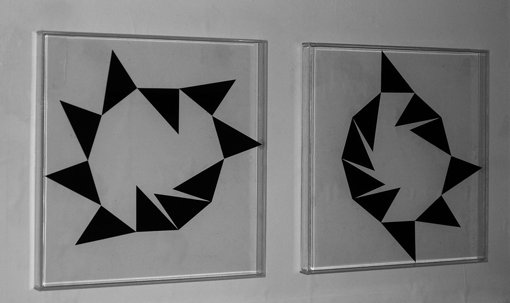
Artist 34: Kara Walker
Kara Walker, born 1969 in California, this African American
artist is best known for her black and white cut-paper silhouettes. She was introduced to art early on in
her life, her father is a formally trained artist and allowed her to sit with
him as he worked. Walker’s work
addresses some very highly controversial themes throughout history. In 1991 she received her Bachelors in
Fine Arts from Atlanta College of Art, three years later she received her
Masters in Fine Arts from the Rhode Island School of Design. In that same year, 1994, her mural
“Gone, An Historical Romance of a Civil Was as it Occurred Between the Dusky
Thighs of One Young Negress and Her Heart”, gave her the attention of the
world. In 1996, at the age of 27
she became the youngest recipient of the John D. and Catherine T. MacArthur
Foundation’s “genius” grant. In
2007 she had her first full-scale exhibition. She now lives in New York and she teaches visual arts in the
MFA program at Columbia University.
During her art career she has worked in a number of different mediums
but it is her black and white cut-paper silhouettes that are her most
recognizable work. She confronts
many large issues head on, she takes issues like rice, gender, sexuality,
violence and identity and pairs that with a mix of nightmarish yet fantastical
images paired with a cinematic feel.
Artist 33: Estuardo Maldonado
Estuardo Maldonado, born in 1930, is a Latin American
sculptor and painter. His work was
very highly influenced by the Constructivist movement. Born in Ecuador he was very influenced
by nature and at a young age he left home to set out to observe and learn from
nature. What he learned and saw
during his time spent in nature has been a huge inspiration for many of his
works. He studied at the School of
Fine Arts in Guayaquil and by 1953 he was teaching drawing and art history at
the American School of Guayaquil.
Then in 1955 Malsonado traveled along the coast painting the people and
landscapes of the Ecuadorian coast.
That same year he held his first exhibition. A year later he was the first Ecuadorian artist to exhibit
sculpture at the House of Ecuadorian Culture. Then in 1957 Maldonado headed to Europe on a scholarship and
settles in Rome while there he attended the Academy of Fine Arts of Rome and
the Academy of San Giacomo. His
work combines the innovation of Constructivism with the influence of nature and
the history of his people. Then in
2009 he was awarded the Premio Eugenio Espejo, which is his country’s most
prestigious National Award for Art, Literature and Culture.
Artist 32: Elias Wakan

Elias Wakan, born in 1945, is a constructivist sculptor in
British Columbia. His work was
very similar to that of the artists in the Russian Constructivist
movement. He uses thousands of pieces
of identical wood to create his sculptures. He uses straight edged rectangles and triangles to create
his over all pieces that end as curved, abstract sculptures but they were still
very geometric. He studied mathematics
and philosophy at Stanford University.
He then spent years traveling in South America, India and the
Yukon. After his years abroad he
moved to Ontario and used his knowledge of spatial problems and structure to
design and build an underground solar house. He was later accepted by the Emily Carr Institute of Art and
Design, but instead of attended the art school he decided to go to Japan where
he spent two years studying the photography of form and pattern. Upon his return he created geometric
paper sculptures that he later turned into wooden forms.

Artis 31: Max Bill
Max Bill was a Swiss designer, born in 1908. From 1924 to 1927 he was in an
apprenticeship as a silversmith, but then went to study at the Bauhaus in
Dessau until 1929. He then moved
to Zurich and in 1944 he became a professor at the school of the arts on
Zurich. Then in 1953 Bill along
with a few others founded the Ulm School of Design in Germany. It started out in the same tradition as
Bauhaus, but later took a new approach on education, integrating art and science. Although the Ulm School of Design
opened in 1953 by 1968 it was closed.
Max Bill was an industrial designer and his work was characterized by
clear designs and precise proportions.
He tried to create visual
representations of the New Physics of the early 20th century, he
wanted to make art in a way that the new science could be understood by the
senses. Bill was not a
rationalist, he was a phenomenologist, he understood that the ultimate
expression of concrete art was embodiment. He became a member of the Swiss National Council in 1967 and
a professor at an art school in Hamburg at the same time. Then in 1973 he became an associate
member of the Royal Flemish Academy of Science, Literature and Fine Arts in
Brussels, three years later he became a member of the Berlin Academy of
Arts. In 1983 he created a granite
sculpture that was installed as public art next to the Bahnhofstrasse in
Zürich.
Subscribe to:
Posts (Atom)